
What is mortgage amortization?
Key takeaways
- Mortgage amortization is the process of making recurring mortgage payments to pay down your mortgage loan.
- An amortization schedule shows your specific payment timeline based on your loan term, breaking down due dates and showing your payment progress so you can better understand it.
- It also details specific information about your loan, such as whether it’s a 15-year or 30-year loan, or a fixed-rate or adjustable-rate mortgage (ARM).
- You can make extra payments to help pay down your mortgage balance, which can help you pay less mortgage interest over time, depending on your loan terms and payment activity.
What is mortgage amortization?
Mortgage amortization is another term for the process of paying back your mortgage loan in regular installments.
As you make payments, you'll gradually reduce your loan principal while also paying accrued interest. The longer your amortization period, the lower your monthly payment will be, and you will likely pay more money on interest.
What is a mortgage amortization schedule?
A mortgage amortization schedule breaks down the makeup of your recurring mortgage payments, so you can understand what to expect and estimate the associated long-term costs.
A mortgage amortization schedule shows a timeline of all your payments and their due dates. This schedule can help you track your progress and understand how much of your payment goes toward your loan principal and interest.
Note that your mortgage payment consists of not just principal and interest, but also includes factors like property taxes, mortgage insurance, homeowners insurance, and escrow account information (if applicable). Read more about the components of a mortgage payment.
An amortization schedule includes two key components:
- Loan information, such as your total loan amount, interest rate, total amortization period, and your balance after each payment
- Payment information, such as the amount of each payment, the frequency of your payments (e.g., monthly, bimonthly, etc.), and what percentage of your payments go toward loan principal and interest
Amortization and fixed-rate mortgages?
Amortization will look different for you depending on whether your mortgage has a fixed or adjustable rate.
With a fixed-rate mortgage, your principal and interest payments will stay the same over the life of your loan. Realistically, that means a few things:
- Your payments will be more predictable, since you will be making equal recurring payments.
- At the beginning of your payments, most of those funds will go toward interest first.
- As time goes on, most of your payment will go toward the loan principal.
30-year fixed rate
Most fixed-rate mortgage loans come in 15-year or 30-year terms, which is how long it will take you to pay off the loan.
- 30-year mortgages often have a higher interest rate, but your overall monthly payments will be lower. Many mortgage loans in the United States have a 30-year term and could provide more available lending options if you pursue a 30-year fixed-rate loan.
15-year fixed rate
In contrast, 15-year mortgages will typically create higher monthly payments for you, with the potential to build equity faster. 15-year mortgages also tend to have lower interest rates than 30-year mortgages.
15-year fixed-rate loans may be harder to qualify for than a 30-year loan, since the monthly payments are larger. You would have to demonstrate to your lender that you can afford the higher monthly payment before you are approved.
Amortization and adjustable-rate mortgages (ARM)
If you obtain an adjustable-rate mortgage (or ARM), your monthly payments start at a fixed rate for a set period, typically the first 3-10 years. Once that period is over, your interest rate becomes variable, which means your payments could increase or decrease over time.
- Your monthly payment may be adjusted depending on the loan terms (commonly every 6-12 months).
- Your lender will recalculate your payments and provide a new payment amount based on your total payment history, the length of your loan, and your remaining balance.
- Like a fixed-rate mortgage, most of your payments go toward interest first, then shift toward your principal over time.
What is the formula for mortgage amortization?
Lenders will provide a mortgage amortization schedule and break down the costs for you, but if you're looking to calculate your mortgage amortization schedule for yourself, you can use the formula below:
Monthly Payment = P x r (1+r)n / by ((1+r)n – 1)
- P = loan amount
- r = monthly interest rate
- n = number of payments
Example mortgage amortization schedule
Let’s view a sample mortgage amortization schedule for a $360,000 loan with a fixed interest rate of 6.0% over 15 years.
The table below breaks down your first 12 payments, which total $3,037.88 per month for the life of your loan. The table also shows how much of that monthly payment goes toward your principal versus interest, along with the balance after each payment.
| Payment Number | Payment Date | Beginning Balance | Monthly Payment | Principal Paid | Interest Paid | Ending Balance |
|---|---|---|---|---|---|---|
| 1 | Apr-2025 | $360,000.00 | $3,037.88 | $1,237.88 | $1,800.00 | $358,762.12 |
| 2 | May-2025 | $358,762.12 | $3,037.88 | $1,244.07 | $1,793.81 | $357,518.04 |
| 3 | Jun-2025 | $357,518.04 | $3,037.88 | $1,250.29 | $1,787.59 | $356,267.75 |
| 4 | Jul-2025 | $356,267.75 | $3,037.88 | $1,256.55 | $1,781.34 | $355,011.20 |
| 5 | Aug-2025 | $355,011.20 | $3,037.88 | $1,262.83 | $1,775.06 | $353,748.37 |
| 6 | Sep-2025 | $353,748.37 | $3,037.88 | $1,269.14 | $1,768.74 | $352,479.23 |
| 7 | Oct-2025 | $352,479.23 | $3,037.88 | $1,275.49 | $1,762.40 | $351,203.74 |
| 8 | Nov-2025 | $351,203.74 | $3,037.88 | $1,281.87 | $1,756.02 | $349,921.88 |
| 9 | Dec-2025 | $349,921.88 | $3,037.88 | $1,288.28 | $1,749.61 | $348,633.60 |
| 10 | Jan-2026 | $348,633.60 | $3,037.88 | $1,294.72 | $1,743.17 | $347,338.88 |
| 11 | Feb-2026 | $347,338.88 | $3,037.88 | $1,301.19 | $1,736.69 | $346,037.69 |
| 12 | Mar-2026 | $346,037.69 | $3,037.88 | $1,307.70 | $1,730.19 | $344,730.00 |
| Payment Number | Payment Date | Beginning Balance | Monthly Payment | Principal Paid | Interest Paid | Ending Balance |
|---|---|---|---|---|---|---|
| 169 | Apr-2039 | $35,296.97 | $3,037.88 | $2,861.40 | $176.48 | $32,435.57 |
| 170 | May-2039 | $32,435.57 | $3,037.88 | $2,875.71 | $162.18 | $29,559.87 |
| 171 | Jun-2039 | $29,559.87 | $3,037.88 | $2,890.09 | $147.80 | $26,669.78 |
| 172 | Jul-2039 | $26,669.78 | $3,037.88 | $2,904.54 | $133.35 | $23,765.25 |
| 173 | Aug-2039 | $23,765.25 | $3,037.88 | $2,919.06 | $118.83 | $20,846.19 |
| 174 | Sep-2039 | $20,846.19 | $3,037.88 | $2,933.65 | $104.23 | $17,912.54 |
| 175 | Oct-2039 | $17,912.54 | $3,037.88 | $2,948.32 | $89.56 | $14,964.21 |
| 176 | Nov-2039 | $14,964.21 | $3,037.88 | $2,963.06 | $74.82 | $12,001.15 |
| 177 | Dec-2039 | $12,001.15 | $3,037.88 | $2,977.88 | $60.01 | $9,023.27 |
| 178 | Jan-2040 | $9,023.27 | $3,037.88 | $2,992.77 | $45.12 | $6,030.50 |
| 179 | Feb-2040 | $6,030.50 | $3,037.88 | $3,007.73 | $30.15 | $3,022.77 |
| 180 | Mar-2040 | $3,022.77 | $3,037.88 | $3,022.77 | $15.11 | $0.00 |
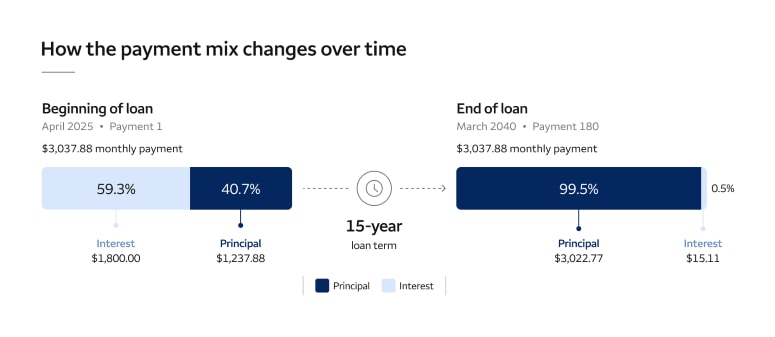
This graphic shows how a mortgage payment is split between interest and principal over the life of a 15-year loan. As time goes on, this balance gradually shifts. More of each payment is applied to the principal, which helps reduce the remaining principal amount faster. This is a common pattern with amortized loans: early payments are mostly interest, while later payments mainly reduce the loan balance.
How does making extra payments affect amortization?
Making extra payments on your loan can help you pay down your mortgage. When you make extra payments outside your amortization schedule, you can reduce the total amount of interest that accrues on your loan and build equity in your home.
Some borrowers may wish to pay down their mortgage to prioritize other financial or life goals. Check out more information on how to pay down your mortgage.
Closing summary
Knowing your loan’s amortization details can help you manage your monthly mortgage payments more effectively and understand how you gradually build equity in your home. Utilizing an amortization schedule can also give you a thorough breakdown of what to expect for your monthly payments.
Talk with your lender about your mortgage amortization as you move through the homebuying process, so you understand what is expected of you.
Amortization FAQs
Talk to a mortgage consultant
Call us
1-877-510-2079
Mon – Fri: 7 am – 8 pm
Sat: 8 am – 6 pm
Central Time
Marque 9 para recibir atención en español.
Let us contact you
Enter your contact information to have a mortgage consultant call you.
Find a consultant
Use our locator to search for mortgage consultants in your area.
If you extend your loan term, you may pay more interest over the life of your loan.
If you are a service member on active duty, an eligible spouse, partner, or dependent, or currently receiving SCRA benefits, please consult with your legal advisor prior to seeking a refinance of your existing mortgage loan. In some cases, a refinance may impact your eligibility for benefits under the Servicemembers Civil Relief Act or applicable state law.
How was your experience? Give us feedback.
Wells Fargo Home Mortgage is a division of Wells Fargo Bank, N.A.
DT1-09032027-12-9110423-1.1
