
Sustainability
,gravity=Center)
Sustainability
Wells Fargo seeks to meet the financial needs of our customers, clients, and communities. We take a client-centered approach to sustainability and sustainable finance, and focus on doing what banks do best – providing financing and expertise to help clients pursue their objectives. Consistent with this approach, we are pursuing the developing commercial opportunity to address the evolving sustainability-related needs of clients across a broad range of sectors of the U.S. economy. We seek to meet the financial needs of our customers, whether they are seeking to pursue their sustainability goals or make their businesses more resilient.
Wells Fargo is also making progress to strengthen our operational sustainability. Across certain offices and branches, we are installing energy and water efficiency measures and innovative building technologies. We are also procuring renewable electricity to power a number of those facilities. These investments can help lower long-term operating costs and improve the experience of employees and customers, while also supporting the Company’s operational sustainability goals.
The information below provides insights into the Company’s ongoing work related to sustainability, including progress towards our sustainable finance and operational sustainability goals. It also highlights our support for communities and employees, and provides information on certain corporate governance activities.
We are proud of the positive contributions we are making in service of our clients and communities.
Sustainability Disclosure Index
For more information on our sustainability-related policies and practices please refer to our Sustainability Disclosure Index (PDF), which includes links to additional information and disclosures mapped to Global Reporting Initiative (GRI), Sustainability Accounting Standards Board (SASB), and Task Force on Climate-related Disclosures (TCFD) reporting frameworks.
Forward-Looking Statements. Information contained on the Sustainability site speaks only as of the date of its publication on August 21, 2026, unless otherwise noted. We undertake no obligation to update the information, whether as a result of new information, future developments or otherwise, except as may be required by law. Forward-looking information contained on this site is subject to risks and uncertainties. Refer to the “Disclaimer and Forward-Looking Statements” section below and to our reports filed with the Securities and Exchange Commission for additional important information, including factors that could cause actual results to differ materially from our expectations.
Sustainability approach
Wells Fargo leverages its scale and expertise to support sustainability and resilience for our operations, clients, and communities. Our approach is client-centric. As clients’ sustainability-related needs evolve, Wells Fargo is preparing to meet those needs and pursue the developing commercial opportunity.
Our efforts to embed sustainability into our operations enable us to test and deploy solutions that can lower operating costs, increase resiliency, and connect our teams with emerging innovations. This work is supported by our commitment to maintaining a strong risk and control culture, along with governance practices that help us adapt to and manage in a rapidly changing world.
We developed our sustainability approach by considering industry best practices, voluntary standards and frameworks, and a range of stakeholder viewpoints, and we assess where our internal business strategy aligns with sustainability-related opportunities. We engage with stakeholders including non-governmental organizations and industry associations.
$500B
in sustainable finance by 2030
2050 goal
of net zero greenhouse gas emissions in scopes 1 and 2
70% reduction
in greenhouse gas emissions (scopes 1 and 2) from 2019 levels by 2030
50% reduction
in energy usage from 2019 levels by 2030
50% reduction
in total waste stream from 2019 levels by 2030
45% reduction
in water usage from 2019 levels by 2030
100%
of annual purchased electricity consumption needs with new renewable sources by 2030
Financing sustainable activities
We aim to help our clients pursue their climate and sustainability-related objectives. Our approach is client-driven, as we aim to support their unique needs — from resiliency and financial health to bespoke and structured sustainability-labeled transactions.
The Sustainability team brings expertise, relationships and resources that support our lines of business as they work with clients to help them achieve their sustainability objectives. The team seeks to improve enterprise integration and coordination of sustainability-related work. Key activities include providing subject matter expertise to bankers and clients on relevant market trends and policies, engaging with external stakeholders, and driving internal awareness and education.
At Wells Fargo, we support our clients and customers in pursuing their objectives which may include sustainability-related opportunities. In 2021, Wells Fargo set a goal to finance or facilitate $500 billion in sustainable finance by 2030 to support our clients and customers as they pursue opportunities in both existing and emerging areas of sustainability. For more information on sustainable finance activities that count toward our goal, see Sustainable Finance at Wells Fargo (PDF).
From 2021 to 2025, Wells Fargo originated, committed, advised, or facilitated approximately $321 billion in sustainable finance activities, representing approximately 64% of our $500 billion sustainable finance goal. Wells Fargo’s Institute for Sustainable Finance highlights examples of our sustainable finance initiatives.
,gravity=Center)
| Cumulative total | Percent of total | |
|---|---|---|
| Sustainability-linked loans and bonds | $84 billion | 26% |
| Sustainability bonds | $45 billion | 14% |
| Social loans and bonds | $33 billion | 10% |
| Green loans and bonds | $30 billion | 9% |
| Subtotal | $192 billion | 60% |
| Cumulative total | Percent of total | |
|---|---|---|
| Energy generation and storage | $29 billion | 9% |
| Clean transportation | $22 billion | 7% |
| Green buildings | $10 billion | 3% |
| Energy efficiency | $8 billion | 2% |
| Pollution prevention and control and circular economy | $2 billion | 1% |
| Sustainable water and wastewater management | $2 billion | 1% |
| Other environmental | < $1 billion | <1% |
| Subtotal | $72 billion | 23% |
| Cumulative total | Percent of total | |
|---|---|---|
| Housing affordability | $37 billion | 12% |
| Economic opportunity development | $18 billion | 6% |
| Other community | $1 billion | <1% |
| Subtotal | $56 billion | 18% |
| Cumulative total | Percent of total | |
|---|---|---|
| Total sustainable finance | $321 billion | 100% |
Operational sustainability
Wells Fargo’s Corporate Properties Group supports our operational sustainability goals by facilitating efforts to reduce energy and water usage, reduce waste, source renewable energy, and reduce our Scope 1 and Scope 2 emissions. The team also partners with lines of business to provide insights and information to clients developing their operational sustainability strategies, including renewable energy strategies and building performance standards.
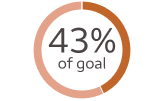
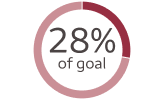
70% Reduction
in Scope 1 & 2 GHG Emissions from 2019 levels (43% of goal)
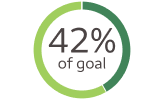
50% Reduction
in energy usage from 2019 levels (42% of goal)
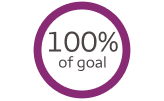
50% Reduction
in waste stream from 2019 levels (100% of goal)
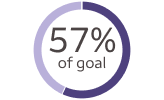
45% Reduction
in water usage from 2019 levels (57% of goal)
100% of our annual purchased electricity consumption needs with new renewable sources
For more information, please see our Operational Sustainability Performance Data (PDF).
In 2025, Wells Fargo signed 3 renewable energy agreements supporting the construction of new solar assets in the Carolinas, Florida, and Oklahoma, reinforcing our long-term strategy to support new sources of renewable energy.
Additionally, in 2025, Wells Fargo proudly announced the opening of its new campus in the Las Colinas neighborhood of Irving, Texas. The campus has direct access to public transit and is designed to produce more energy annually than it consumes. The 22-acre campus incorporates cutting-edge technology with new buildings that are equipped with solar power, smart irrigation systems, and dynamic glass that responds to sunlight and weather for optimal heating, cooling, and lighting conditions.
Much of our operational sustainability work is multi-year and ongoing. Highlights from 2025 include:
- Meeting our waste reduction goal as part of our continued efforts to improve operational efficiency by 2030;
- Implementing composting at several Wells Fargo U.S. campuses as part of our broader ongoing waste management program;
- Continuing to install high-efficiency lighting and lighting controls across Wells Fargo’s building footprint;
- Improving mechanical system efficiency through deployment of building management systems; and
- Continuing water reduction practices including our ongoing smart irrigation program which leverages smart controllers to reduce irrigation water consumption.
February 2025 statement on Wells Fargo’s climate goals & targets
Wells Fargo has long been a leading bank in the energy sector, financing conventional and low-carbon energy solutions. As of December 31, 2024, we had approximately $55 billion of outstanding commitments to oil, gas, pipeline companies, and utilities, and we have provided over $20 billion of renewable tax equity since 2006. We have also deployed $178 billion of sustainable finance in three years, which includes $16 billion in renewable energy and over $15 billion in clean transportation finance.
Wells Fargo can play a role in supporting our clients’ climate-related efforts. However, when we set our financed emissions goal and targets, we said that achieving them was dependent on many factors outside our control. This included public policy, consumer behavior, and technology changes that would enable our clients to move quickly to lower-emitting operating models. Many of the conditions necessary to facilitate our clients’ transitions have not occurred.
We are adjusting our approach to focus on doing what banks do best – providing financing and expertise to help clients pursue their own objectives. As of February 28, 2025, we discontinued our sector-specific 2030 interim financed emissions targets and our goal to achieve net zero by 2050 for financed emissions.
We will maintain our 2030 sustainable finance goal; our 2030 operational sustainability goals; and our 2050 goal for Wells Fargo’s own operational emissions. Most importantly, we will continue to serve clients’ energy needs, meeting them where they are in their chosen energy and transition strategies. And we will work to meet the rising energy demands of the clients, customers, and communities we serve.
Sustainability governance
The management and oversight of sustainability-related risks are integrated into the risk programs supporting our businesses across the enterprise.
We leverage line of business risk and control committees for decision-making and escalation of risks and controls associated with sustainability-related activities. These committees include leaders from various lines of business and enterprise functions.
The Enterprise Risk & Control Committee reports to the Risk Committee of the Board of Directors and governs the management of all risk types. The committee is co-chaired by the Chief Executive Officer and Chief Risk Officer, with members including the heads of principal lines of business and certain enterprise functions. It is the most senior management committee responsible for reviewing and approving significant sustainability decisions.
At the Board level, the Governance and Nominating Committee oversees the Company’s significant strategies, policies, and programs on social and public responsibility matters. The Risk Committee of the Board of Directors oversees the state of the Company's risk programs, including risks related to sustainability.
Indigenous Peoples Statement
For more than 65 years, Wells Fargo has provided capital and financial services to tribes and tribal-owned enterprises. Wells Fargo has banking relationships with 1 out of every 3 federally recognized tribes in the United States. We have committed approximately $5.6 billion in credit and hold approximately $4 billion in deposits for tribal governments and tribally owned enterprises nationally, banking more than 240 federally recognized Native American and Alaska Native tribes across the U.S. We are dedicated to serving Indigenous communities with products, services, and financial health programs tailored to help tribal clients, tribal governments, tribal enterprises, and tribal members succeed financially.
While the government of the United States provides formal recognition to American Indian and Alaska Native tribes, for purposes of this statement we use the term Indigenous Peoples to be inclusive of these communities and other tribal communities that may or may not be afforded the same recognition in their countries outside the United States.
As expressed in Wells Fargo’s Human Rights Statement, we are committed to respecting human rights.
We recognize that the identities and cultures of Indigenous Peoples are inextricably linked to the lands on which they live and the natural resources, including air and water, upon which they depend.
We seek to respect the rights of Indigenous Peoples and we recognize the rights of these communities to meaningful and appropriate consultation regarding issues affecting their sacred lands and natural resources.
While we recognize that governments have a central role to play in the approval of policies or projects that impact Indigenous Peoples, we seek to understand how our customers manage the impacts and risks of their activities. Through due diligence, Wells Fargo may engage with clients to understand their approach to managing potential impacts and risks to Indigenous communities. We intend to pursue high-quality business opportunities informed by appropriate assessment, applying risk management principles throughout our decision-making process.
Philanthropy and community impact
We focus on three priorities for our community impact – improving housing access and affordability, accelerating business growth, and empowering financial opportunity. We seek to deepen our impact by collaborating with customers and community organizations that share our commitment to stronger communities. In addition, Wells Fargo supports the development of strong communities through disaster relief funding and engages employee volunteers across a range of local initiatives.
Since 2019, Wells Fargo & Company and the Wells Fargo Foundation have given more than $2 billion in support of housing, business growth, financial health and more, to help communities thrive with financially resilient families, vibrant businesses and affordable places to call home.
Employee support
At Wells Fargo, we strive to be a great place to work where our employees can grow meaningful careers while supporting our efforts to serve a broad set of customers and clients. Listening to and learning from our employees helps us enhance the employee experience and drive improvements to our culture, programs, and processes. We offer work-life benefits from career development and skill-building opportunities to competitive compensation and well-being support. We believe that by investing in our people, we’re investing in our future.
Questions?
Email sustainability@wellsfargo.com
View Sustainability Disclosure Index (PDF)
Visit Reporting and resources
Disclaimer and Forward-Looking Statements
The information on the Sustainability site is provided for information purposes only and reflects Wells Fargo & Company’s (“our” or the “Company’s”) approach to the topics on this site as of August 21, 2026, unless otherwise noted. Our approach is subject to change in the Company’s sole discretion without notice. The Company undertakes no obligation to update this site, or any information contained on this site, as a result of new information, future developments, or otherwise, except as may be required by law. Any goals, objectives, commitments, initiatives, or other information discussed on this site are not guarantees of future results, occurrences, performance, or conditions.
This site contains forward-looking statements about our business and other future conditions, including statements about the Company’s goals, objectives, commitments, and initiatives related to sustainability, governance, human capital, and human rights. Because forward-looking statements are based on our current expectations and assumptions regarding the future, they are subject to inherent risks and uncertainties. Do not unduly rely on forward-looking statements as actual results could differ materially from expectations.
While there is no assurance that any list of risks and uncertainties or risk factors is complete, important factors that could cause actual results to differ materially from those in the forward-looking statements include the following, without limitation: measurement uncertainties or other limitations with respect to data, methodologies, and models; the evolving standards and methodologies for measuring, reporting and verifying metrics; the development and adoption of new technologies and business models; the need for collaboration and action on the part of various stakeholders to help achieve goals, objectives, commitments and initiatives; the potential impact of legal and regulatory obligations and changes in laws, regulations, or public policy; changes in stakeholder perceptions and expectations; and changes in management’s strategies including our goals, objectives, commitments, and initiatives. For additional information about factors that could cause actual results to differ materially from our expectations, refer to our reports filed with the Securities and Exchange Commission, including the discussion under “Risk Factors” in our Annual Report on Form 10-K for the year ended December 31, 2025, as filed with the Securities and Exchange Commission and available on its website at www.sec.gov.
Terms on this site are intended as references to the internally defined criteria of the Company and, except as specifically stated, not to any similar terms used by third parties or any jurisdiction-specific regulatory definition that may exist. Any references to terms such as “significant,” “important,” “critical,” “material,” or similar terms should not be read as necessarily rising to the level of materiality of disclosures required under U.S. federal securities laws or other laws and regulations.
The Company’s goals, objectives, commitments, and initiatives are aspirational and purely voluntary, are not binding on the Company's business, investment decisions, and/or management, and may be amended or cancelled at any time. The Company’s goals and initiatives related to greenhouse gas emissions should not be construed as a commitment by the Company to achieve a particular emissions-related outcome or a claim to realize a specific climate effect.
Information contained on this site is sourced from a variety of internal and third-party sources and may be based on emerging or evolving practices, assumptions, or estimates. The suitability of the design and effectiveness of any third-party systems and associated controls over the accuracy and completeness of such third party’s data, methodologies, or models has not been independently assessed by us.
The Company makes no representations or warranties as to the quality, completeness, accuracy, or fitness for a particular purpose of any information on this site and shall not be liable for any use by any party of, for any decision made, or action taken by any party in reliance upon, or for any inaccuracies or errors in, or omissions from, such information. This site should not be used as a basis for trading in the securities of the Company or for any other investment decision. Unless otherwise indicated, the information on this site has not been verified or otherwise assured by an independent third party.
The information presented on this site does not provide the official plan provisions of the employee benefit plans sponsored by the Company, to the extent applicable. If there is any discrepancy between the information presented on this site and the official plan documents, the official plan documents will govern. The Company reserves the right to amend, modify, or terminate any of its benefit plans, programs, policies, or practices at any time, for any reason, with or without notice.
Any external links to third-party websites are provided for your convenience, but the Company does not endorse and is not responsible for the content, links, privacy policy, or security policy of such websites. The use of any third-party trademarks or brand names is for informational purposes only and does not imply an endorsement by the Company or that such trademark owner has authorized Wells Fargo to promote its products or services. The Company disclaims any representations or warranties regarding the non-infringement of any information contained on this site.
How was your experience? Give us feedback.
When we refer to “Wells Fargo,” “the Company,” “we,” “our,” or “us,” we mean Wells Fargo & Company and its consolidated subsidiaries.
The sustainable finance activities shown meet Wells Fargo’s Sustainable Finance Eligibility Criteria. Totals may not sum due to rounding. Subcategories with less than 1% are categorized as “Other environmental” or “Other community.” “Other environmental” includes sustainable management of natural resources and biodiversity, and “Other community” includes education and healthcare.
DT1-01082027-18-8136163-1.1
